Last checked: 6 November 2026. I re-check every figure on this page each quarter.
Your reviews are now the first thing a new customer checks, and often the deciding one. The 2026 research shows the bar rising fast: more stars, more reviews, newer reviews, and a reply from you to every one.
Most figures here come from BrightLocal’s Local Consumer Review Survey 2026, the longest-running survey of its kind (1,002 US adults, published 11 February 2026). Where I’ve used other sources, they’re named.
The short answer
- Almost everyone reads reviews: 97% read reviews for local businesses, and 41% always do (up from 29% a year earlier).
- Four stars is now the floor for 68% of people, up from 55% in 2025.
- Fewer than 20 reviews puts off nearly half of customers (47%).
- Old reviews barely count: 74% look for reviews from the last three months.
- Most people will review you if you ask: 83% of those asked went on to write one.
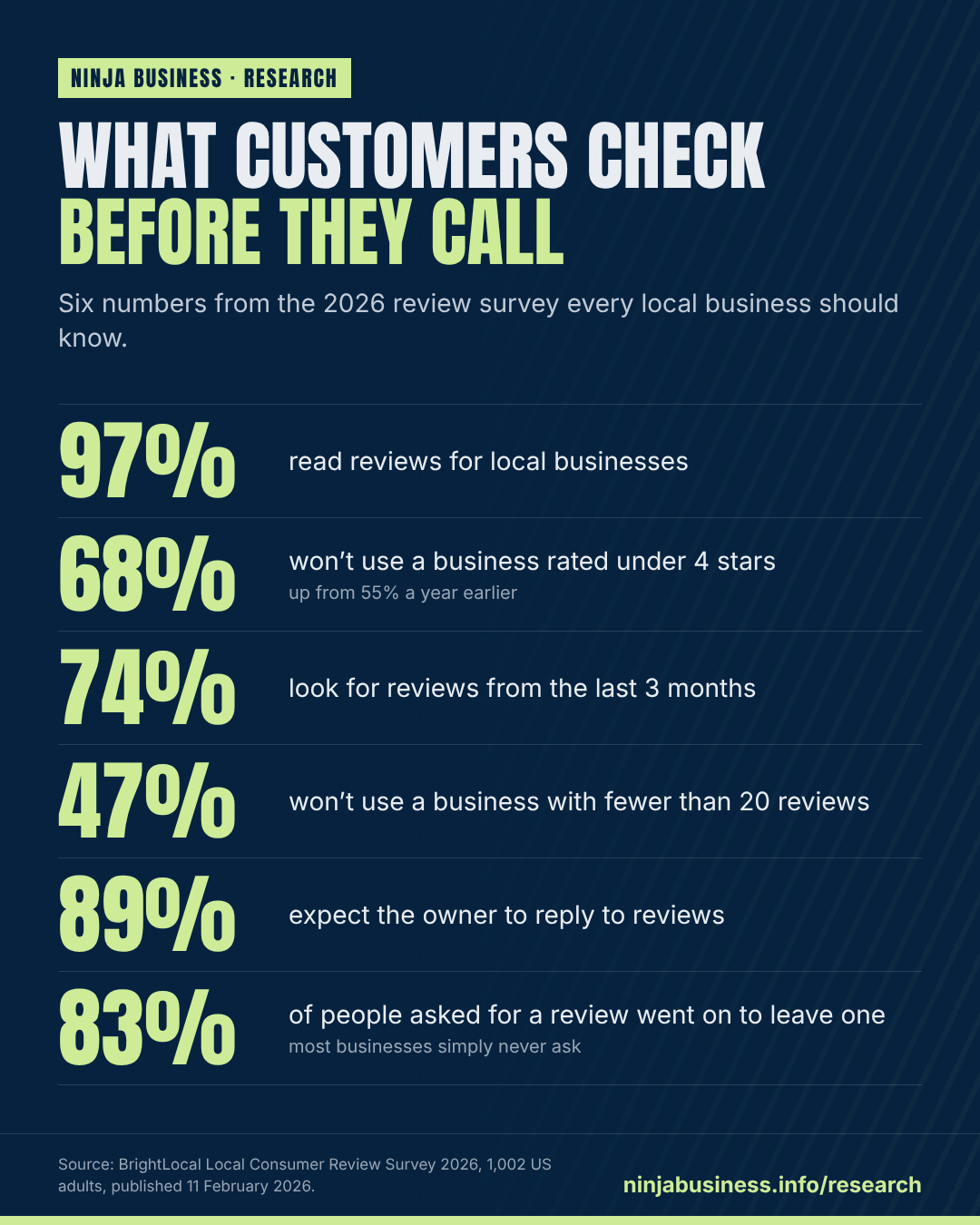
Use this infographic
You’re welcome to use it on your own site, in a newsletter or in a talk. All I ask is a link back to this page. Copy the code below and paste it into your page’s HTML.
<a href="https://ninjabusiness.info/online-review-statistics/"><img src="https://ninjabusiness.info/wp-content/uploads/2026/11/review-stats-social-1080x1350-1.png" alt="What customers check before they call. Infographic by Ninja Business" width="540" height="675"></a><br>Infographic: <a href="https://ninjabusiness.info/online-review-statistics/">Online review statistics 2026</a> by Ninja BusinessHow customers use reviews
| What was measured | Figure | Change |
|---|---|---|
| Read reviews for local businesses | 97% | Steady |
| Always read reviews when choosing a business | 41% | Up from 29% in 2025 |
| Consider star ratings | 92% | |
| Use Google to read reviews | 71% | Down from 83% |
| Use ChatGPT or other AI tools for local recommendations | 45% | Up from 6% |
| Use Apple Maps to read reviews | 27% | Up from 14% |
| Read AI-generated review summaries | 82% | |
| Would decide on the AI summary alone | 23% | |
| Number of review sites the average consumer uses | 6 | |
| Trust reviews about as much as personal recommendations | 49% | Up from 42% |
Two shifts stand out. Customers are spreading across more places to check you out, and AI tools have gone from almost nothing to the third most-used source in a year. Those tools summarise what your reviews say, so a thin or stale review profile now shows up in more places than Google.
How good, how many, how recent
| Customers who… | Figure |
|---|---|
| Will only use a business with 4 stars or more | 68% (up from 55%) |
| Will only use a business with 4.5 stars or more | 31% (up from 17%) |
| Will only use a 5-star business | 10% |
| Won’t use a business with fewer than 20 reviews | 47% |
| Won’t use a business with 5 or fewer reviews | 9% |
| Look for reviews from the last three months | 74% |
| Look for reviews from the last two weeks | 32% (up from 20%) |
| Only consider reviews from the last week | 18% |
| Say negative reviews make them less likely to use a business | 77% |
Put together, a business with 12 reviews averaging 4.3 stars, the newest from last year, falls short for a large share of customers on all three counts. Plenty of good local businesses are in exactly that position, not because their work is poor but because nobody asks.
Replying to reviews
| Customers who… | Figure |
|---|---|
| Expect the owner to respond to reviews | 89% |
| Are likely to use a business that responds to all its reviews | 80% |
| Are unlikely to use a business that never replies | 42% |
| Are unlikely to choose a business that uses generic, templated replies | 50% |
| Expect a reply within a week | 81% |
| Expect a reply the same day | 19% (up from 6%) |
The message is clear: reply to every review, good and bad, in your own words, within a few days.
Asking works
- 83% of people who were asked to leave a review went on to write one (BrightLocal 2026).
- 28% say they will always write a review if asked, up from 16% in 2025.
- 94% say they’re open to writing reviews, and 69% wrote at least one in the past year.
- 73% of US homeowners say they would refer a business after excellent service (Housecall Pro survey of 1,040 homeowners, October 2025).
Your happy customers are willing. The gap is almost always that nobody asked them at the right moment, with an easy link.
Figures to stop quoting
| The claim | Where it comes from | Verdict |
|---|---|---|
| “88% of consumers trust online reviews as much as personal recommendations” | BrightLocal’s 2014 survey. Most of that yes had conditions attached, and the question has changed since. | 12 years out of date. The 2026 figure is 49%. |
| “One extra star means 5–9% more revenue” | A Harvard Business School study of Yelp ratings and Seattle restaurants, 2003 to 2009. The effect was for independent restaurants; chains showed none. | Real, but narrow and old. Fine to quote for independent restaurants, with the date. Don’t apply it to a roofer. |
| “You need five stars” | A common assumption. | Not true. Only 10% insist on five stars. Four or more matters far more (68%). |
What the rules say about fake and incentivised reviews
The pressure to get more reviews has led some businesses to buy or bribe them. That’s now a real legal risk on both sides of the Atlantic, and 97% of consumers think businesses caught doing it should be punished (BrightLocal 2026).
- United States: the FTC’s rule on consumer reviews, announced 14 August 2024, bans buying fake reviews, offering incentives for reviews with a particular sentiment, undisclosed reviews from insiders, and suppressing negative reviews with threats. It lets the FTC seek civil penalties.
- United Kingdom: since April 2025, the Digital Markets, Competition and Consumers Act bans posting or commissioning fake reviews. The CMA can now fine businesses up to 10% of global turnover for breaking consumer law.
- Google: its policy bans offering payment, discounts or freebies for reviews, discouraging negative reviews, and selectively asking only happy customers (“review gating”).
The safe, effective approach is simple: ask every real customer, offer nothing in return, and make it one tap to leave a review. This isn’t legal advice; if you’re unsure about a specific practice, check with a lawyer.
What it means for a small business
- Ask every customer, every time, by text or email shortly after the job, with a direct link to your Google review form.
- Aim for a steady stream, not a burst. Recency matters more each year: a few new reviews every month beats fifty from 2022.
- Get past 20 reviews, the point where nearly half of customers stop being put off.
- Reply to every review within a few days, in your own words.
- Ask your happiest customers to refer you at the moment they’re happiest.
Review requests on autopilot
I set up systems that ask every customer for a review after each job, automatically and within the rules, alongside an AI front desk that answers your calls. Ring mine on +1 (903) 501-2211 and see what it’s like.
How I checked these figures
I opened every source below on 6 November 2026. BrightLocal’s survey is of US adults, so treat it as a strong guide rather than an exact match for UK customers. Survey figures measure what people say they do, which isn’t always what they do. Spotted something newer? Email hello@ninjabusiness.info.
Sources
- BrightLocal, Local Consumer Review Survey 2026, 11 February 2026, 1,002 US adults.
- Housecall Pro, Home service customer service report, survey of 1,040 US homeowners, October 2025.
- Harvard Magazine, HBS study finds positive Yelp reviews lead to increased business, October 2011 (Michael Luca, “Reviews, Reputation, and Revenue: The Case of Yelp.com”).
- Carly, Online review statistics (history of the 88% figure).
- Federal Trade Commission, Final rule banning fake reviews and testimonials, 14 August 2024.
- Competition and Markets Authority, New consumer protection regime comes into force, 7 April 2025.
- Google, Maps user-contributed content policy: fake engagement.