Last checked: 6 November 2026. I re-check every figure on this page each quarter.
Search for missed-call statistics and you’ll find the same numbers on dozens of sites: 62% of calls go unanswered, 85% of callers never ring back, missed calls cost $126,000 a year. I went looking for where those numbers come from. Several of them come from nowhere.
This page sets out the figures that are backed by real data, the popular ones that aren’t, and what the honest numbers mean if you run a small business that lives on the phone.
The short answer
- Somewhere between a quarter and almost half of business calls never reach a person, depending on whose data you use (28% on CallRail’s platform, 44% across 70 million calls on Invoca’s).
- Only about 1 in 7 missed callers actually leaves a voicemail (15%, from 18 million missed calls on Quo, July to September 2026).
- About 1 in 5 immediately rings another business (21%, CallRail survey of 1,000 US consumers, 2025).
- Most missed calls are never returned: 69% got no callback within 48 hours (Quo, 16.7 million missed calls, 2026).
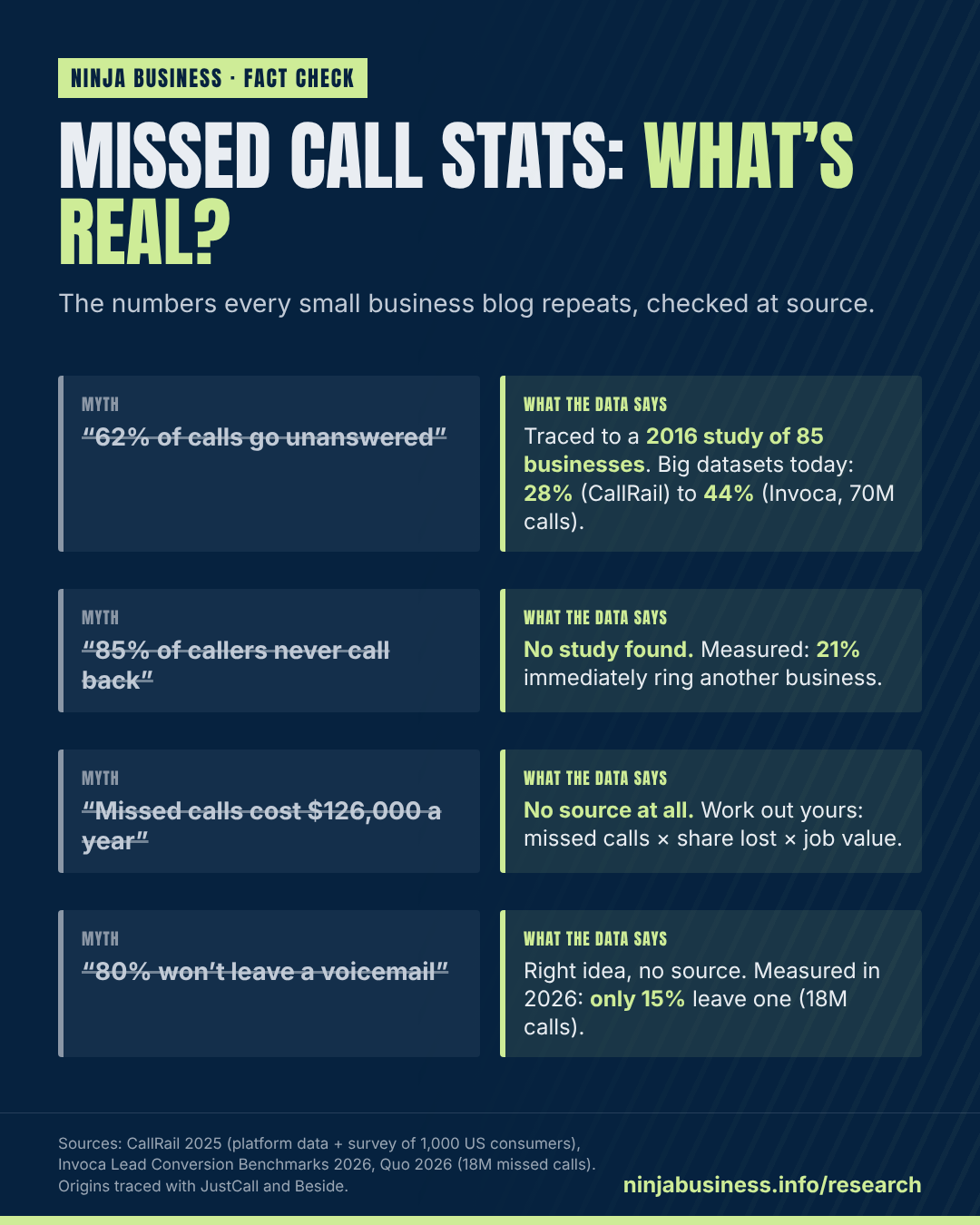
Use this infographic
You’re welcome to use it on your own site, in a newsletter or in a talk. All I ask is a link back to this page. Copy the code below and paste it into your page’s HTML.
<a href="https://ninjabusiness.info/missed-call-statistics/"><img src="https://ninjabusiness.info/wp-content/uploads/2026/11/missed-call-myths-social-1080x1350-1.png" alt="Missed call statistics: what's real? Infographic by Ninja Business" width="540" height="675"></a><br>Infographic: <a href="https://ninjabusiness.info/missed-call-statistics/">Missed call statistics, fact-checked</a> by Ninja BusinessThe figures that hold up
Each of these comes from a named source with a stated sample and date. I’ve opened every one.
| What was measured | Figure | Source, sample and date | How solid |
|---|---|---|---|
| Calls to businesses that never reach a person | 44% | Invoca Lead Conversion Benchmarks 2026: 70 million+ calls, 10 industries, published July 2026 | Measured. Invoca’s customers already track their calls, so the true figure for all businesses is probably worse. |
| Calls to businesses that go unanswered | 28% | CallRail platform average, September 2025 | Measured, on CallRail customers. No sample size published. |
| Missed calls by industry | Healthcare 32%, legal 28%, home services 14%, real estate 9% | CallRail small business benchmark report, January 2025 | Measured, on CallRail customers. |
| Missed callers who actually left a voicemail | 15% (14% after hours) | Quo: 18 million+ missed calls, July to September 2026 | Measured behaviour. The best voicemail figure available. |
| Consumers who say they leave a voicemail | 42% | CallRail survey of 1,000 US consumers, 2025 | Survey. What people say, not what they do. Compare Quo’s measured 15%. |
| Consumers who immediately call another business | 21% | Same CallRail survey | Survey. |
| Consumers who have abandoned a business after an unanswered call | 78% | Same CallRail survey | Survey. |
| Missed business calls with no callback within 48 hours | 69% | Quo: 16.7 million missed calls over three months, 2026 | Measured. Ranges from 59% to 79% by industry. |
| Homeowners who say speed influences who they hire | Nearly all | Housecall Pro survey of 1,040 US homeowners, October 2025 | Survey. |
| UK callers who didn’t leave a voicemail | 69% | Moneypenny Small Business Call Report: 300 micro businesses plus call data from 10,000 businesses, November 2016 | Real but 10 years old. |
The figures that don’t
These are the numbers you’ll see most often. Here’s where they actually come from.
| The claim | Where it comes from | Verdict |
|---|---|---|
| “62% of calls to small businesses go unanswered” | Traced back to a January 2016 study of just 85 businesses. | Out of date and tiny. Use Invoca’s 44% (70 million calls) or CallRail’s 28% instead. |
| “85% of callers who don’t get through never call back” | No traceable study. Even CallRail’s own January 2025 press release says “up to 85%” and links to a blog post with no method behind it. | Unsourced. The closest real figure is 21% who immediately ring someone else. |
| “80% of callers won’t leave a voicemail” | Usually credited to Forbes or a receptionist service, with no study attached. | Right idea, wrong source. Quo’s 2026 data now measures it properly: about 85% of missed callers leave no voicemail. |
| “Missed calls cost the average small business $126,000 a year” | No primary source found. It appears on vendor blogs that cite other vendor blogs. | Made up. Work out your own figure instead (below). |
| “Reply within 5 minutes and you’re 100 times more likely to reach them” | A 2007 study by MIT and InsideSales of outbound sales calls to web leads. | Real, but nearly 20 years old and about sales teams chasing web leads, not customers ringing a business. |
| “Firms that reply within an hour are 7 times more likely to qualify a lead” | Harvard Business Review, “The Short Life of Online Sales Leads”, 2011. | A real study, but 15 years old and about B2B web leads. The direction still holds; the exact multiple is dated. |
Credit where it’s due: JustCall’s and Beside’s own fact-checks were useful in tracing several of these claims back to their origins.
What it means for a small business
The honest numbers are still bad news. If a quarter or more of your calls go unanswered, and only about 1 in 7 of those callers leaves a message, then most missed callers are people you’ll never know about. Some of them were ready to book.
It hits hardest where the owner is also the one doing the work: trades, salons, therapists, instructors. The phone rings when your hands are full, and the caller has two other numbers open.
Work out your own number
Forget the $126,000. Your call log and invoices beat any survey:
missed calls a week × share who go elsewhere × average job value × 52
An example with made-up but ordinary figures: 5 missed calls a week, 1 in 5 going elsewhere (close to CallRail’s 21%), and a $400 average job. That’s one lost job a week, or about $20,800 a year. Your own figures may be higher or lower; the point is to use them.
What actually helps
- Answer more calls. A receptionist, an answering service or an AI receptionist that picks up when you can’t.
- Reply to every missed call quickly, the same day at the latest. Quo’s data shows a callback that doesn’t happen on the day usually doesn’t happen at all.
- Give people a way to book without calling: online booking or a website chat that can book them in.
How I checked these figures
I opened every source listed here on 6 November 2026 and only included figures where the source names its sample and date. Two things to keep in mind:
- Platform data comes from each company’s own customers. Businesses that pay for call tracking are already paying attention to their phones, so the real-world picture is probably worse than these figures.
- Surveys measure what people say they do, not what they do. When CallRail asked, 42% said they’d leave a voicemail. When Quo measured, 15% did.
Spotted a figure I’ve missed, or a newer study? Email hello@ninjabusiness.info and I’ll check it for the next update.
Hear what answering every call sounds like
I set up AI front desks for small businesses. Ring mine on +1 (903) 501-2211 or try the chat, and see whether you could catch it out.
Sources
- Invoca, Lead Conversion Benchmarks Report 2026, July 2026.
- CallRail, How missed calls are costing your business, 11 September 2025.
- CallRail, Why businesses can’t afford to miss calls, September 2025 (survey of 1,000 US consumers).
- CallRail, small business benchmark report press release, January 2025.
- Quo, Why only 15% of callers leave a voicemail, 2026.
- Quo, Small business callback statistics, August 2026.
- Housecall Pro, Home service customer service report, survey of 1,040 US homeowners, October 2025.
- Moneypenny, Small Business Call Report, November 2016.
- Harvard Business Review, The Short Life of Online Sales Leads, March 2011.
- Fact-checks used to trace origins: JustCall, Missed call statistics; Beside, What missed calls cost a small business.